Autonomous Security
Your Linux fleet secures itself.
Autonomously secures Linux 24/7, continuously finding vulnerabilities and configuration drift, deciding what needs to change, fixing it and verifying the result.
First 5 hosts free. No credit card. No kernel modules.
Supported Linux distributions
Debian 12 · Ubuntu 22.04 / 24.04 · RHEL 9 · AlmaLinux 10 · Rocky · SUSE · Amazon Linux
Autonomous Security / Live Fleet
Linux fleet: 247 protected hosts
Security state: Protected
| Autonomous | Status |
|---|---|
| prod-db-07 · CVE-2026-44192 remediated | Verified |
| api-prod-12 · sshd configuration hardened | Verified |
| edge-04 · openssl package upgraded | Verified |
| erp-prod-02 · CIS drift corrected | Verified |
| Continuous observation | On |
| Autonomous remediation | On |
| Post-fix verification | On |
The problem
Linux security should not be a queue of work.
Traditional security products find problems. They scan your systems, generate CVEs, identify failed controls and create tickets. Then somebody still has to investigate the finding, decide what matters, determine the right change, execute it and check whether it worked.
Autonomous Security doesn’t give your team more security work. It does the security work.
Autonomous by design
From finding to fix autonomously, in minutes.
Don’t patch at human speed, patch at machine speed. To apply patches continuously observes every protected Linux system, understands what has changed, decides what action is required, remediates the machine and verifies that the security issue is gone.
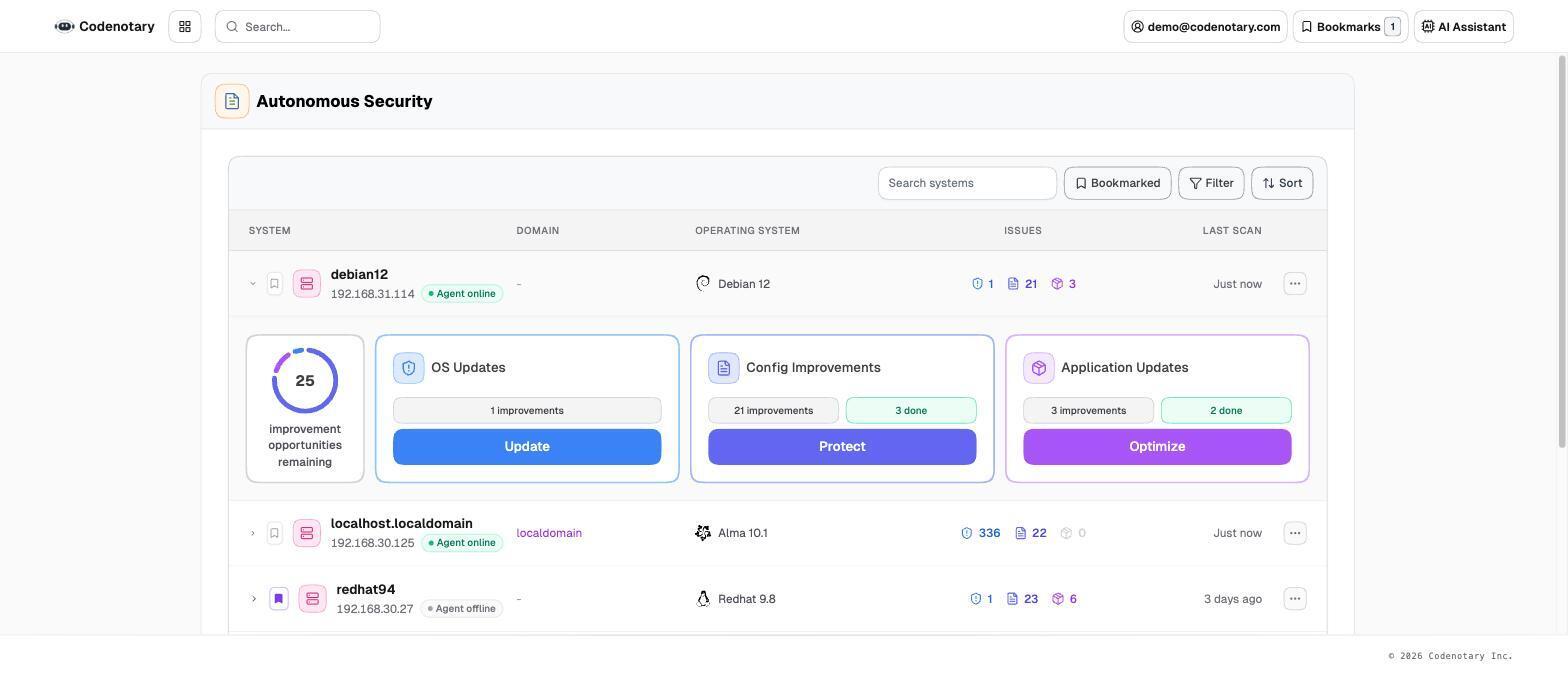
Continuous awareness
Always watching your Linux fleet.
Linux security posture changes continuously. New vulnerabilities appear, exploit code is published, packages change, administrators modify configuration and machines drift.
Autonomous Security maintains a continuously updated understanding of every protected machine and acts on what it discovers.
Every host. Continuously.
Operating system, packages, CVEs, configuration, controls and security state are continuously evaluated.
Risk understood in context.
Exploit intelligence and actual machine state determine what requires action.
No dashboard watching required.
Trust acts without waiting for somebody to notice another red number.
$ Autonomous Security fleet status
| Host | Live | Status |
|---|---|---|
| prod-db-07 | RHEL 9.7 · checked 8 seconds ago | Secure |
| api-prod-12 | Ubuntu 24.04 · checked 11 seconds ago | Secure |
| erp-prod-02 | AlmaLinux 10 · CIS drift detected | Remediating |
| edge-04 | Debian 12 · openssl updated | Verifying |
Autonomous vulnerability remediation
Don’t manage CVEs. Remove them.
A Linux server can carry hundreds or thousands of known vulnerabilities. Treating every CVE as another ticket creates an endless backlog.
Correlates vulnerabilities with exploit intelligence, affected packages, available fixes and the actual machine state. It determines what matters, remediates the system and checks again.
Exploit-aware prioritization
Public proof-of-concept code and offensive tooling separate immediate risk from background noise.
Exact remediation
Trust identifies the package and fixed version needed to eliminate the vulnerability.
Verified outcome
Remediation ends only after Autonomous Security confirms the machine is no longer vulnerable.
$ Autonomous Security vulnerability activity
| CVE | Autonomous | Status |
|---|---|---|
| CVE-2026-44192 | public exploit · openssl · upgraded to fixed version | Remediated |
| CVE-2026-39012 | exploit tooling available · package replaced | Verified |
| CVE-2026-28071 | package present · vulnerable path not applicable | No action |
| CVE-2026-19803 | no known exploit · no fixed package currently available | Monitoring |
Continuous Linux hardening
Linux that stays hardened.
A hardened server does not stay hardened automatically. Configuration changes, application installs, updates and operational work introduce drift.
Continuously evaluates the system against security policy and CIS benchmarks and autonomously brings it back into the desired security state.
Continuous CIS evaluation
Hundreds of controls covering authentication, networking, permissions, services, kernel configuration and logging.
Automatic drift correction
Recognizes when a previously secure system changes and restores the required security state.
Continuous verification
Security is measured by resulting machine state, not simply whether a command returned successfully.
$ Autonomous Security hardening activity
| Control | 24 / 7 | Status |
|---|---|---|
| SSH root login | config drift → secure state restored → verified | Corrected |
| File permissions | CIS control 6.1.3 · compliant | Verified |
| Kernel network configuration | insecure parameter changed → verification passed | Hardened |
| Audit logging | CIS benchmark continuously enforced | Compliant |
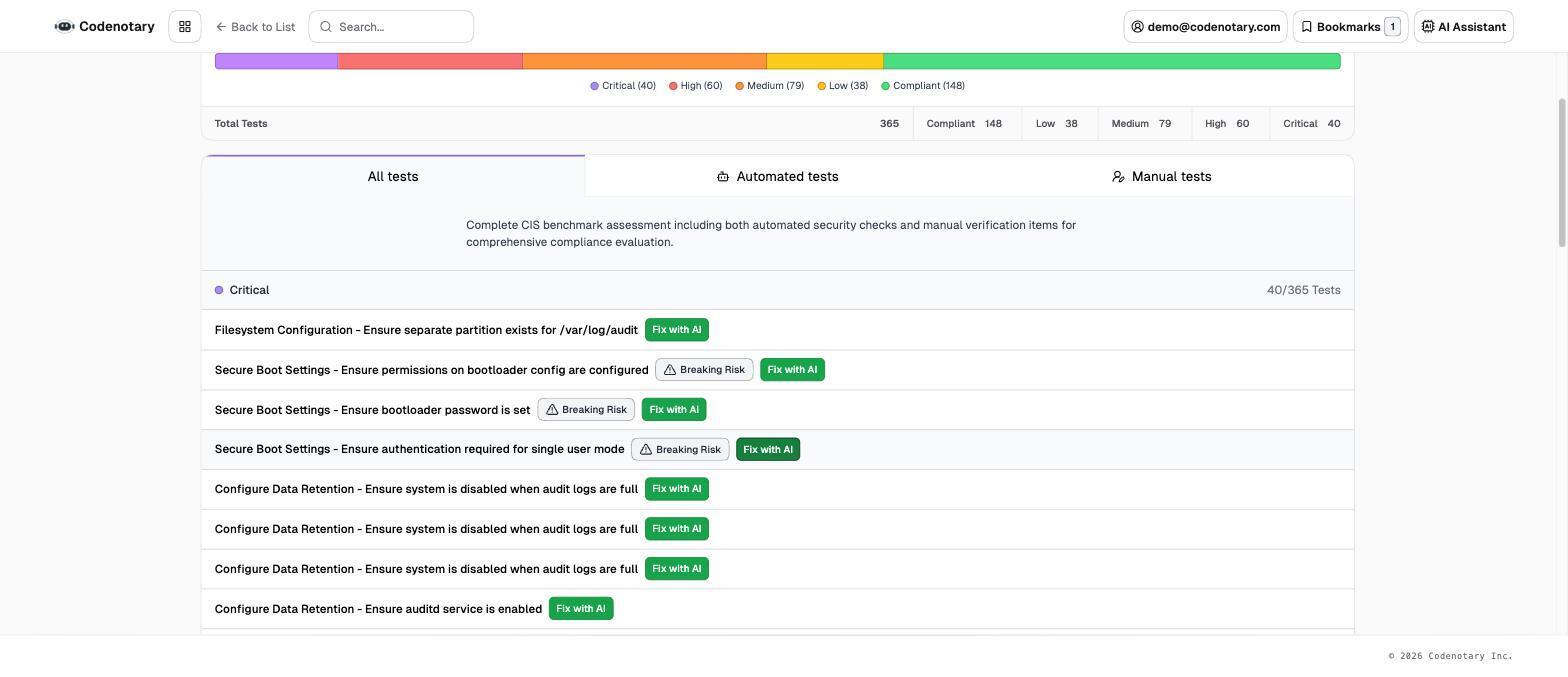
Machine-speed security
Vulnerabilities don’t keep office hours. Neither does Autonomous Security.
A vulnerability can be disclosed at 2 a.m. A configuration can drift on Sunday. Exploit code can appear while your security team is asleep.
Don’t wait for someone to log into a dashboard.
24/7
Continuous autonomous Linux security.
365
CIS controls evaluated per host.
1
Continuous security loop from detection through verification.
0
Security queues required to keep routine Linux risks closed.
One autonomous system
Everything required to keep Linux secure.
Patching, hardening and compliance aren’t separate jobs in Autonomous Security. They are outcomes of the same continuously operating security system.
01
Vulnerability remediation
Discover kernel and userspace vulnerabilities, correlate them with exploit intelligence, apply the appropriate fix and verify the result.
02
Linux hardening
Continuously enforce secure configuration and automatically correct security drift as systems change.
03
Continuous compliance
Maintain CIS and security posture continuously instead of preparing machines immediately before an audit.
04
Exploit intelligence
Prioritize vulnerabilities using public exploit code, offensive security tooling and real machine state.
05
Autonomous verification
Checks the resulting system state after every remediation rather than assuming the action worked.
06
Tamper-evident evidence
Maintain a verifiable record of what was discovered, what changed, when it changed and what the resulting state was.
Autonomous and accountable
Autonomous does not mean invisible.
Every action Autonomous Security takes becomes part of a tamper-evident security history. See what Trust discovered, what decision it made, what it changed and whether the resulting machine state was secure.
Autonomous operation with a verifiable record of what happened and why.
Continuous compliance
Audit evidence becomes a by-product of security.
Compliance should not require spending two weeks preparing Linux servers for an audit.
Because Autonomous Security continuously evaluates, hardens and secures systems, compliance evidence reflects the actual state of your infrastructure.
Stop asking:
“Can we get compliant before the audit?”
Start asking:
“Show me that these machines remained secure.”
Autonomous Security / Security Evidence
| Evidence | Live | Status |
|---|---|---|
| CIS Benchmark | continuously evaluated | Compliant |
| Vulnerability posture | evidence generated from current fleet state | Verified |
| Remediation history | who · what · when · resulting state | Immutable |
| Audit report | PDF · CSV · XLS | Ready |
Start in minutes
One install. Autonomous from there.
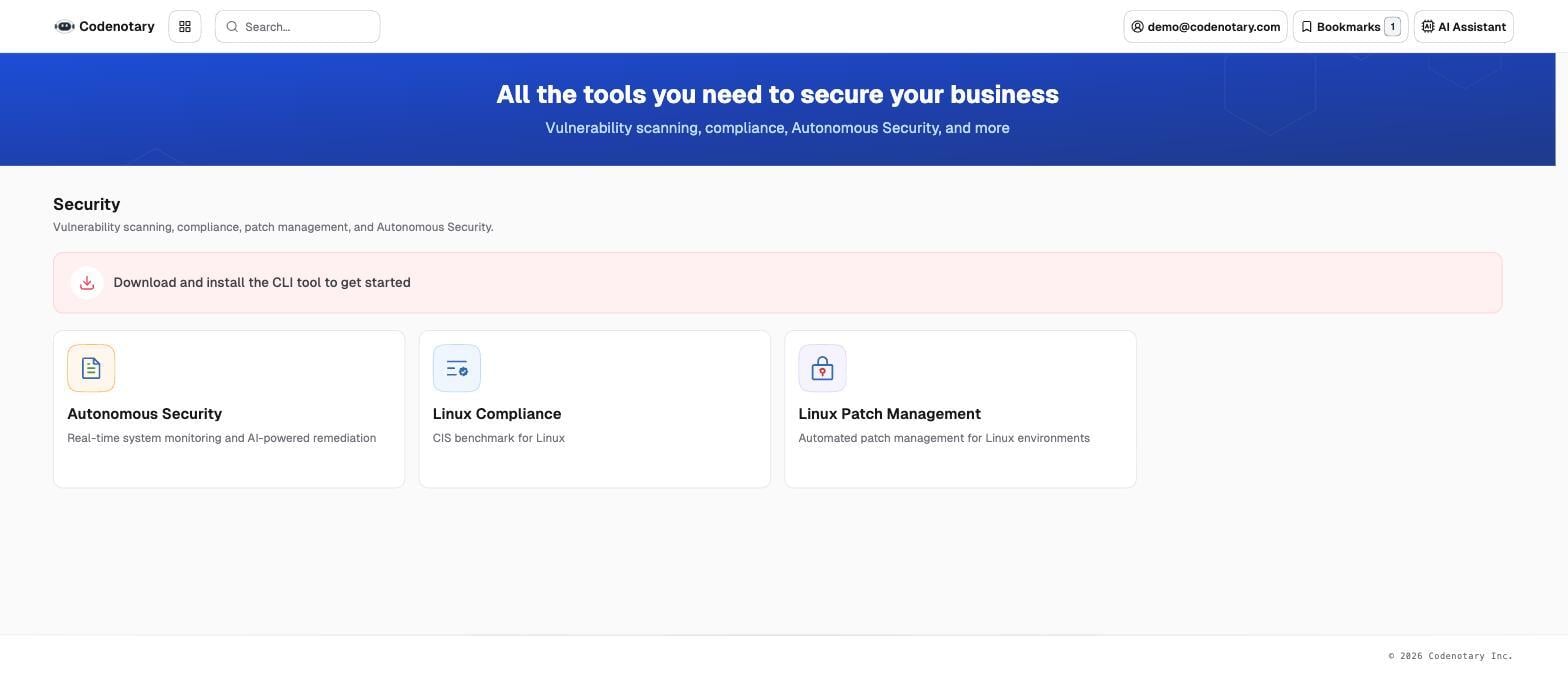
Install Autonomous Security on a Linux host and it begins understanding, protecting and continuously verifying the machine.
- 1
Sign up
Protect your first five Linux hosts free. No credit card.
- 2
Install Autonomous Security
One lightweight installation per host, or deploy across the fleet using your existing automation.
$ curl -sSf https://get.codenotary.com | sh - 3
Autonomous Security secures Linux
Autonomous Security continuously observes, decides, remediates and verifies. 24 hours a day, seven days a week.
Questions Linux teams ask
Autonomous Linux security, without the ambiguity.
Is Autonomous Security just another vulnerability scanner?
No. Scanners report findings. Autonomous Security decides what to do about them, makes the change and verifies the outcome, without a human working through a ticket queue.
Get started
Let Autonomous Security secure your Linux fleet.
First 5 hosts free. No credit card. No kernel modules.